Born 1944.
Sohrab Shahid Sales (1944-98) was born and raised in Iran and studied cinema in Europe. He had made a number of shorts and documentaries by the time he made A Simple Incident (1973) and radically redefined Iranian cinema with a translucent realism that was utterly unprecedented. A year later, Shahid Sales made Still Life, consolidating his position as a leading visionary of his generation. His next film, In der Fremde (Far from Home, 1975), was one of the first films to address the issue of Gastarbe-iter, or the "guest worker," in Germany. Shahid Sales continued to make his films in Germany, funded mainly by German television, and effectively lost his connection with Iranian cinema. Between 1976 and 1992, he made a total of nine films for TV in Germany. Toward the end of his life and before his premature death in Chicago, Shahid Sales moved to the United States where his health rapidly deteriorated—despite the admirable efforts of his friends to save his life. Mehrnaz Saeed Vafa made a fine documentary about his last days in Chicago, and Ali Dehbashi has edited an excellent volume of essays and other material on Shahid Sales' significance as a filmmaker.
"A Simple Incident premiered at the second Tehran International Film Festival, and caught the Iranian cinema scene off guard. No one could believe that such a simple incision of reality could carve through the fat layers of Iranian commercial cinema—pretty much dominating the mass consumption of Iranian films at the time. There were of course those who thought A Simple Incident slow and boring, its pace intolerable. But you will look in vain, even among those who liked and aggressively supported A Simple Incident, for a clue as to why they liked the film—although such standard cliches as "a true cinema" and "an honest cinema" as usual filled in the air.
A Simple Incident is a film of no incident. It is a succession of slighdy, ever so gently, mobile still lifes. There is more motion in Cezanne's paintings than in Shahid Sales' films. The character Mohammad in A Simple Incident is the son of an ailing mother and a forlorn father who makes a meager living by illegal fishing in the Caspian Sea. Mohammad's life is divided between watching his mother die, his father wither away, and his schooling that is entirely irrelevant to the rest of his life. But the film is not tragic; it is lethargic. Its sluggish pace is deliberately languid— with long takes that neither generate nor expect the slightest suggestion of life. There is a weariness about A Simple Incident, an apathetic indolence, that is neither real nor fictive—it is translucently indulgent. It allows for the spontaneity of the real to become see-through, unmitigated, unexplained, inexplicable, standing at the threshold of every and all explanations."
Showing posts with label Director. Show all posts
Showing posts with label Director. Show all posts
Wednesday, 10 June 2015

Sunday, 24 May 2015
Arby Ovanessian (Director)
Born: 1941, Isfahan.
Of Armenian descent.
He worked as a set designer, until 1963 when he traveled to England to study cinema. He returned to Iran in 1966 and became one of the most prominent theater directors of his generation. Before he turned to Spring he had directed a number of shorts, among them a documentary (about thirty minutes) called Lebbeus Whose Surname Was Thaddeus, 1967.
This is an exquisite black-and-white film shot on location about a pilgrimage of Armenians to the mausoleum of a saint, which begins with a contemplative survey of the scared site, culminates in the congregation of the pilgrims, and concludes, after they pack and leave, with a magnificent final shot of the solitary site of the church in the middle of the desert, suddenly covered by a wandering cloud.
Ovanessian's documentary is shot with pious regard for the sanctity of the site, considerable attention to the social character of the event, and the wondrous occasion of a solitary sacred site suddenly transformed into a social event, and then turned back to its originary solitude.
He developed a close collaborative rapport with Ali Mohammad Afghani, though it was suddenly aborted by the unfortunate events surrounding the production otAhu Khanom's Husband.
Burned by that unfortunate experience, Ovanessian turned to an Armenian story by M. Armin, from which he adapted his own screenplay. When it was first released, in 1972, Spring was a box-office disaster, while critically it sharply divided its admirers and detractors—some thinking it beautiful, poetic, lyrical, and revolutionary, while others considered it boring, banal, and complicated.
Tuesday, 17 March 2015
Bahman Farmanara (Director)
 Born: Tehran, 1942.
Raised and educated in Iran, Bahman Farmanara received his higher education at the London School of Music and Dramatic Arts and then at the University of Southern California. In 1966 he returned to Iran and began a career with the National Iranian Radio and Television. His first film was 'Nowruz and Caviar' (1971), a documentary about the famous Iranian delicacy and the poverty of its producers. His first feature film, 'Qamar Khanom's House' (1972), was a complete flop. Soon after that, Farmanara began working at a film production company financed by the royal family. But by 1974, he had quit that dubious distinction and directed Prince Ehtejab, based on the novel by Houshang Golshiri.
At the beginning of the revolution, Farmanara made another film based on Golshiri's story 'Tall Shadows of Wind' (1979). And after the revolution Farmanara moved to France and then to Canada, where he established a film distribution company. In the early 1990s, family matters brought him back to Iran, where he began teaching at the Tehran College of Cinema and Theater. By the end of the decade, Farmanara made a triumphant return to cinema with his wise, mature, confident, and caring Smell of Camphor, Fragrance of Jasmine (2000). Two years later, his House Built on Water created yet another storm of controversy with the censors.
Monday, 16 February 2015
Dariush Mehrjui (Director)
Born: Tehran, 1939.
Proclaims the influence of Italian Neorealism, Eisenstein and D.W. Griffith.
His second feature as director, The Cow, won international and critical acclaim, and was a collaboration with the renowned writer Gholamhossein Saedi, who had also written the initial story the film was based on.
"After his early upbringing and education he left for the United States, where he attended college at the University of California, Los Angeles, studying film, although he graduated with a degree in philosophy. Mehrjui returned to Iran in 1965 and began his long and extraordinarily productive career with a bizarre spoof called Diamond 33 (1965), a frivolous adaptation of the James Bond films—a rather inauspicious beginning for an otherwise seminal figure in Iranian cinema. While in Los Angeles, Mehrjui had become interested in Gholamhossein Saedi's dramatic works, and soon after the fiasco of Diamond 33 he approached Saedi and the two of them began collaborating on the screen adaptation of one of his short stories—"The Cow"—which became by far the most significant achievement of Iranian cinema after the pioneering works of Farrokhzad and Golestan, before the sudden rise of a new generation of visionary filmmakers in the 1980s." [Dabashi, M&M]
His films are mostly adaptations of literary or theatrical works, of Persian or European literature, including 'Woyzeck' and a Henrik Ibsen play.
Ebrahim Golestan (Director)
Born: Shiraz, 1922.
He was a writer of short stories before moving into cinema, influenced by the then golden era of modern Persian literature (e.g. Sadegh Hedayat). He was just as keenly interested by photography and cinema as he was by literature. He was from an upper-middle class background and benefited from advantageous connections. For a while, he was a member of the Iranian Socialist party (Tudeh).
Famously had a professional collaboration and a romantic liaison with Forough Farrokhzad.
Soon after the publication of his second collection of stories, Golestan shifted gear and established his movie studio, Golestan Films, in 1956. A Fire (1958) was among his first productions. The film was directed by Golestan, shot by his younger brother, Shahrokh Golestan and edited by Farrokhzad, was the very first Iranian film to receive acclaim at an international film festival.
In 1963, Golestan made Tappeh-ha-ye Marlik (Marlik Hills), a documentary about archeological excavations in northern Iran, which won him yet another award at the Venice Film Festival.
"There is no escaping the fact that Golestan's The Tide, the Coral, and the Granite (1961) is an effective over-aestheticization and simultaneous de-politicization of the neocolonial robbery of Iranian oil by a corrupt monarchy and a conglomerate of transnational oil companies. But at the same time, there is no escaping the equally important fact that the visual vocabulary of Iranian cinema and the poetic disposition of Golestan's prose are blossoming like beautiful water lilies on the surface of this very dirty swamp. This paradoxical phenomenon is endemic to the politics of Iranian poetics." [Dabashi, M&M]
In 1963, he started filming what is generally considered his masterpiece, the fiction feature Brick and Mirror.
Dabashi labels his style, both in his prose and in his films, as 'affective realism' (in the sense of affectation, artificial etc.). In this he sees an early link to the blend of fact and fantasy taken from pre-modern Persian literary and theatrical (taziyeh) traditions into Iranian cinema.
Sunday, 1 February 2015
Forough Farrokhzad (Culture/History & Director)
 Born: 1935, Tehran. Died: 1967, Tehran (Automobile accident).
More famed as a modernist poet, of iconoclastic and feminist tendencies, she also made her name as a filmmaker with the short documentary about a leper colony, The House is Black, made in 1962.
Before this she had made her first steps into the world of cinema by working with Ebrahim Golestan, whose 1958 documentary A Fire she edited. That documentary, with its Bronze Medal award at the 1961 Venice Film Festival represents the first Iranian film to win international acclaim. She then collaborated on more of Golestan's films. She and Golestan were in love and were rumoured to be having an affair (Golestan being married). She also wrote scripts and acted in a few films. All of this was perfect apprenticeship, but one should not get the idea that filmmaking was particularly important to her creative life. Her poetry remains what is regarded as her greatest achievement and is not diminished in the slightest if one removes her brief brush with cinema. Nor is there any evidence that she value cinema any more than her other non-poetry artistic endeavours, such as painting or travel writing.
The failure of her marriage (she was a 16-year-old bride who convinced her father to let her marry) and subsequent divorce leading to her having to leave behind her only son, were traumatic and guilt-inducing experiences which inspired her art. In a way she had to leave behind her husband and son (and her father, i.e. all three patriarchal symbols) in order to fully emancipate herself as an artist. Dabashi reads in her art a simultaneous fear and attraction to the guilt and shame that consumes her. He also suggests that her own status as social pariah (due to the scandals following her and her supposed promiscuity) is what intuitively led her to relate to the lepers in The House is Black, for they too were marked, literally, as social outcasts.
Dabashi writes: "I feel I have wasted my life," she once wrote in a letter to Golestan, "and know much less than I should at the age of twenty-seven." This was in 1962, by which time she had published three of her five volumes of poetry and made The House Is Black, The same sentiment is evident in her travelogue from her trip to Europe in 1956. Whatever great work of art she saw in Italy left her feeling far more humbled than inspired.
Her works of poetry include the collections:
- Captive (1955)
- The Wall (1956)
- Rebellio (1958)
- Another Birth (1964)
- Let Us Believe in the Beginning of the Cold Season (1967)
Monday, 1 December 2014
Jafar Panahi (Director)
Born 1960. Mianeh, East Azerbaijan region in north-west Iran.
Was assistant to Abbas Kiarostami during the making of Through the Olive Trees. Panahi's short film The Friend in 1992 had been a homage to Kiarostami, before he worked with him or had even met him. Kiarostami then wrote Panahi's debut feature, The White Balloon, which won the Camera d'Or at the Cannes Film Festival and catapulted him to international fame. Soon after that, Panahi made Ayeneh (The Mirror, 1997), which received the Locarno Film Festival's Golden Leopard award. Panahi received even more global recognition with his third feature film, Dayereh (The Circle, 2000), which won the Golden Lion at the 2000 Venice Film Festival.
Filmography:
Features as director:
- The White Balloon (1995)
- The Mirror (1997)
- The Circle (2000)
- Crimson Gold (2003)
- Offside (2006)
- This is Not A Film (2011)
- Closed Curtain (2013)
Sunday, 16 November 2014

Bahram Beyzai (Director)

His output is not limited to cinema. He is a major scholar of Iranian performing arts, and has taught and written on the topic. He is completely at home in classical Persian prose and poetry, painting, music, intellectual history, and philosophical discourse. But he is also equally at home with world cinema. He has written an authoritative book on Chinese theatre. He has directed and written plays, including the very influential 'Four Boxes' (1967), an allegory about oppression.
He is one of the most learned masters of Taziyeh, the Persian passion play.
His first film was a short, made for the Kanun in 1969. In the 1970s he began to emerge as a significant figure in Iranian cinema.
Once the Islamic Republic came to be, Beyzai was among those censored and harassed by its regime.
In the 1990s he made only one film, as his decision to stay in Iran meant he had little opportunity to work. His films also received comparatively little attention from the global cinema community, in part due to their complex nature rooted in the semiotics of Persian mythology, and also in part due to the 'NIC' of the likes of Kiarostami and Makhmalbaf coming to define Iranian cinema internationally while other filmmakers were not given the same amount of scrutiny.
- Dabashi calls his style a form of 'mythic realism', deeply embedded in the symbolism of Persian culture. He wrote of the director: "Beizai is a filmmaker whose cinema, more than anyone else's, is rooted in the deepest layers of Iran's cultural memories, all the way back to its inaugural mythic imaginings"
- Beizai once said, "You see, my duty is to show you things that you have not experienced yet and that are not tangible to you, for things that you already know are no longer of any interest to you. You cannot call these things that I show you unreal. Pages of newspapers are full of incidents, but since they have not happened to us we think they are unreal." [Dabashi, M&M, 257]
Filmography:
- Thundershower (1971)
- Journey (1972)
- The Stranger and the Fog (1974)
- Crow (1976)
- The Ballad of Tara (1979)
- The Death of Yazdegerd (1982)
- Bashu the Little Stranger (1986)
- The Travellers (1992)
Resources:
Wednesday, 20 August 2014
Abbas Kiarostami (Director)
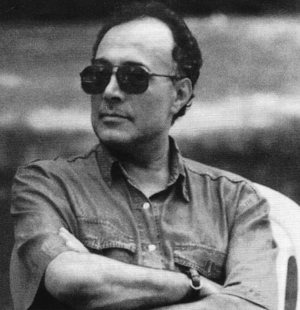 Born: 1940, Tehran
After university (where he studied fine arts/graphic arts), Kiarostami discovered interest in graphic design of which he is quoted as saying “an art that communicates its message to the general public with the minimum of means and the maximum of constraints” – hence a connection with the way he would later be comfortable making films through the constraints of censorship, seeing it as a guiding challenge to find ways around these.
He began his film career making credit titles and commercials. From 1969, he worked at the Institute for the Intellectual Development of Children and Young Adults and established a film department there, directing his first film, a short called Bread and Alley, in 1970. Kiarostami's earliest films (shorts and features) were educational films for children which regularly won prizes at Iran's Fajr Film Festival.
Some aspects of his shorts seem like experiments/tests/rehearsals for his later films. Most obviously the recurring young boy protagonist who struggles in the adult world and must display resourcefulness. But also in the schema of repetitions (e.g. in 'Two Solutions for One Problem', or in 'Orderly or Disorderly?') where even the self-reflexivity comes in with the shots of the clapperboard punctuating the different versions of events being repeated. This reminds of the multiple takes being re-done in Through the Olive Trees for example.
The Institute supported his films up to and including And Life Goes On (1991), after which he has tended to collaborate with the French company MK2.
Style:
Kiarostami's films are elliptical and minimalist. The idea of the 'half-finished' film, inviting creative input from viewers, and the principle of uncertainty, which plays with viewers' expectations, are distinctive aspects.
He works without a script, using mostly non-professional actors (including children) and largely rural or outskirt locations; landscape is an important feature of his post-revolutionary films, as is repetition.
Kiarostami's signature shots are of zigzagging roads. These reflect broad existential statements as well as the particular predicament of his characters. For example, in Where's Is the Friend's Home?, the zigzag path - constructed specifically for the film - signifies the 'hurrying around' of modern life as well as its child protagonist's tortuous quest.
Kiarostami's later films turn increasingly self-reflexive. In these, the blend of documentary and fiction, a characteristic of all his work, is extremely complex. In the earlier works, he often appears as an interviewer; in the later films, he recedes from view, deploying a stand-in, representing a director or producer whose motives we question, filming a film-within-the-film. This self-reflexive trait has roots in Persian storytelling traditions but resonates internationally with European modernist forms. Moreover, Kiarostami's brand of self-reflexivity is inflected by the conditions of Third World filmmaking: the films-within-the-films raise questions about the ethics of middle-class urban outsiders, like Kiarostami himself, who go to remote rural locations in order to film villagers and tribal folk. They highlight the potential for exploiting and exoticising their rural subjects, activating anxiety about replicating the Orientalist gaze.
Another important trait emerging in these films is use of the car as a kind of camera, especially in shots giving the car's point-of-view in place of the driver's point-of-view. Windscreen shots are a staple of A Taste of Cherry. As a zone which is both public and private, the car enables Kiarostami to avoid censorship restrictions on the depiction of private space.
Reception:
Domestic:
Not all negative: "Whoever can describe a tragic event more lamentably we consider that person a more eloquent and capable orator." Golmakani then proceeded to read every technical aspect of Kiarostami's virtuosity with a view toward the highest compliment that an Iranian aesthetician can give an artist: that his art is "impossibly simple," for that is the way we usually describe the work of our great medieval poet, Sa'di (1184—1291). Golmakani is not alone in his praise for Kiarostami. Javad Tusi also has given rather positive reviews of Kiarostami's cinema, with certain reservations. Kiarostami's "realism" in particular is refreshing and healthy in Tusi's reading. He does object, though, to Kiarostami's preference for Vivaldi's music as opposed to any number of jubilant melodies in Persian classical music. Robert Safarian, Reza Dorostkar, and Majid Islami all have had positive responses to Kiarostami's vision. Gholam Heydari, in his theoretically informed book Zaviyeh-ye Did dar Cinema-ye Iran {Point of View in Iranian Cinema, 1990), has included a positive reading of Kiarostami's camera work as a good and relatively consistent example of third-person-singular narrative." [Dabashi M&M, 290]
On the domestic-abroad dialectic: "So as you can see Kiarostami's cinema has received a far more positive reception outside his homeland—unmercifully vilified at home and yet enthusiastically glorified abroad. It is safe to say that had it not been for the accidental chance of the no man's land of film festivals and the naked eyes of a foreign audience, the culturally compromised eyes of Iranians would never have seen what Kiarostami is trying to show. Kiarostami's cinema is, in my judgment, too simple, and the Iranian perspective too conspiratorially compromised, too culturally curtailed, for a revolutionary aesthetic to register in the immediate neighborhood of its own creative vicinity. It seems to me that Kiarostami had to be celebrated abroad in order to be understood domestically at home. This is a bizarre thing to say, but I believe it to be true. A dialectic soon emerged between his foreign admirers who were trying to figure out his cinema and his native audience who were trying to see him otherwise than they had." [Dabashi M&M, 298]
Quotes:
- "I want to create the type of cinema that shows by not showing."
- "My experience in showing this film [Close-Up] in Iran has been quite peculiar. I remember very vividly that after the film was first screened some people came up to me and said, "What was wrong with the sound in the last scene, when Makhmalbaf and Sabzian were driving on a motorcycle? Was something wrong with the sound? Could you not dub it afterward? And some were even suggesting that I intentionally screwed up that scene.... None of the Iranian viewers could follow that I had an intention other than showing the conversation between the two men. .... But viewers in Berlin all recognized that scene as an exceptionally good one, fall of innovation. The director of the academy, who is one of the great German filmmakers, told me, "I wish I could cut this section of your film and keep it for myself." It never occurred to any of the [German] viewers that that scene was accidentally screwed up, or that I had done a trick. They viewed the film as a mode of filmmaking, and they liked the film for that reason, and I think that perhaps precisely for this reason people did not like the film in Iran. At any rate, I am absolutely convinced that we are an intelligent people, and I do not think that Iranian viewers lack anything in comparison with European viewers. Actually, when I compare the reviews that Iranian critics have written on my films with those written by European critics, I come to the conclusion that the Iranian critics are very intelligent. The only distinction that exists, in my judgment, is our politics-stricken consciousness, as a result of which we confront a product maliciously. In addition, since we have not yet passed through the melodramatic period [in our filmmaking], we still look for story. Thus when we confront a film, instead of trying to find out what it wants to convey, we are more interested in what we want to understand by it, and if we come up short [in our reading] then We swiftly dismiss the film and refuse to connect with it." [From a 1992 interview with the important Iranian magazine 'Film', which was largely sympathetic to Kiarostami unlike other domestic publications such as Sumeh, and quoted in Dabashi M&M p288.]
- "If you wanted to reduce Kiarostami to a single idea, you would be not far wrong in saying that he has spent his career developing a cinematic equivalent to Iranian modernist poetry" - Godfrey Cheshire
Filmography:
- The Bread and the Alley
- Experience
- The Traveller
- ..
- The Report
- ..
- Where is the Friend's House?
- Homework
- Close Up
- Life and Nothing More...
- Through the Olive Trees
- Taste of Cherry
- The Wind Will Carry Us
- ABC Africa
- Ten
- Five (2004)
- 10 on Ten (2004)
- ...
Resources:
‘Abbas Kiarostami: A Cinema of Questions’ –
Godfrey Cheshire (Film Comment 1996)
Thursday, 24 July 2014
Mohsen Makhmalbaf (Director)
 Born: 1957, Tehran.
"The young Makhmalbaf, meanwhile, was growing up in downtown Tehran under the protective custody of three mother figures: his mother, his maternal grandmother, and his maternal aunt, who formed a modest, devoutly religious family. They also saved him from being kidnapped by his father, who had married Makhmalbafs mother as his second wife, for he did not have a son from his previous marriage; now he had a son whom he desperately wished to claim. Makhmalbaf thus grew up with three strong mother figures, no father, an overwhelming fear of being kidnapped by his father, all at a time when "the father of the nation," as we were told to call the king, was struggling to keep his shaky throne.
Leftist intellectuals for their part were meanwhile busy soul-searching. Religious revolutionaries were by and large silent. A literary and poetic form of resistance was taking shape. Makhmalbafs mother worked as a nurse in a hospital and his upbringing was entrusted to his grandmother and aunt. His grandmother was intensely religious and told him colorful stories of saints and prophets as lullabies during summer nights on the rooftop of their modest home. His aunt soon started teaching him how to read and write, and introduced him to literature. His mother was the breadwinner, his grandmother the pious storyteller, and his aunt his teacher. No father in sight.
Makhmalbafs mother married the lawyer who had assisted her during her divorce proceedings. Makhmalbafs stepfather was a devout religious man with strong political convictions; he was deeply committed to a young rebellious cleric called Ayatollah Ruhollah Khomeini. In the young Makhmalbafs mind, the stepfather and the revolutionary father figure begin to replace his own estranged father and "the father of the nation," while the material evidence of his livelihood, soul, and intellect remained entrusted to three mothers"[Dabashi, M&M, 337]
"He once told me that his local mosque sent him on a mission to go to Hosseiniyeh Ershad, the religious establishment in which regular anti-regime lectures were organized, in order to plot the assassination of Ali Shariati. He went there, sat and listened to Shariati, and became mesmerized by his revolutionary ideas, and never set foot in his local mosque again, The active hostility of the traditional clerical establishment against Shariati remained a major component of the ideological movement of the mid-1970s. Shariati drew his constituency in part from disaffected youth from religious backgrounds, but also from secular activists disappointed with the legacy of the Tudeh Party."
"After a visit with Khomeini in Najaf in 1974, a group of Mojahedin-e Khalq activists seceded from their main body and formed a more overtly Marxist group called Peykar. This marked a succession of breakups in the urban guerrilla movement. But the general atmosphere of insurrection only intensified, and Makhmalbaf and his small band of comrades began plotting an attack on a police officer in order to steal his gun, rob a bank, and get more seriously involved in the armed uprising against the regime. Makhmalbaf was the leader of the group and chiefly responsible for disarming the police officer, which he failed to do, and was almost killed in the process. He was shot in his belly, captured, initially hospitalized, and then sent to jail in August 1974. He escaped with his life because he was too young to be executed. In the Pahlavi prison, he underwent severe and systematic torture, the scars from which still mark his body."
"Makhmalbaf had now completed his third year of incarceration. He still has bitter memories of how political prisoners who belonged to organized groups were vicious in their behavior toward people like him who were not part of their cliques. In prison, he once told me, he also learned the art of brevity, because he had to memorize instructions, abbreviate and summarize them, in order to communicate them to his cellmates. That art of brevity soon became a hallmark of his asceticism, and in turn found its way into his aesthetic minimalism, and from there into the virtual realism that defines his cinema."
"Around this time [1981, Iran-Iraq war raging] Makhmalbaf wrote Marg-e Digari (Someone Else's Death), an allegorical encounter between a general in his bunker on the verge of a massive military operation and Death. It is a claustrophobic reflection on the incomprehensible ability of people to kill other human beings. All through these years, Makhmalbafs cinema was being formed and imagined (in his mind alone) in the most traumatic experience of Iran's recent national history."
"During this entire year [1983] Makhmalbaf was busy making his next two films, Esteazeb (Fleeing from Evil to God) and Do Chasbm-e Bi-Su (Two Sightless Eyes)—artistically negligible and ideologically at the service of the Islamic Republic. Nevertheless, these films witnessed a noticeable improvement in his command over the camera, a distinct visual vocabulary, and a creative confidence. The critical community of Iranian cineastes began to take notice of Makhmalbaf beyond his ideological identification with the ruling Islamists."
"During this time, Makhmalbaf began to take his chosen profession more seriously and read extensively on cinema. He was equally prolific in writing fiction,. completing two short stories, "Valeh" and "Zangha" ("The Bells"); during the summer, he started working on his best-known novella, Bagh-e Bohr (The Crystal Garden), and in the fall he wrote Hoz-e Soltun (The Soltun Pond), another novella. These two works of fiction deeply complicate an appraisal of his early creative record, for there is not a trace of the committed ideologue in any one of them. It seems as if he had put his cinema at the service of the Islamic revolution, while his fiction remained the exclusive domain of cultivating his own aesthetic concerns. Most who categorically (and correctly) dismiss his early cinema have never bothered to read or consider his fiction of this very same period. They radically differ from his films, as if they were written by an entirely different person. As the war and the revolution raged, these two novellas saved Makhmalbaf for posterity."
"Makhmalbaf made Nobat-e Asheqi (Time of Love) and Shabha-ye Zayandeh-rud (The Nights of Zayandeh-rud). He also wrote Khab-e bi-Ta'bir (The Dream with No Interpretation) and Mard-e Na-Tamam {The Incomplete Man). Banned by the government, The Nights of Zayandeh-rud continues with the same philosophical relativism as Time of Love, this time casting a bitter look at events before and after the Islamic revolution. At the center of the story is a professor of sociology who loses his wife in a motorcycle accident before the revolution, because no one would help him take her to the hospital. In the course of the revolution, the same professor witnesses the love and care that people then had for each other. After the revolution, he sees the same indifference has returned. Not much of an addition to Makhmalbaf's cinematic vision, The Nights of Zayandeh-rud is more an indication of Makhmalbaf's own frustration and disappointment with the revolution"
"Iran remained neutral during the Iraqi invasion of Kuwait and the subsequent invasion of Iraq by the United States and its allies in 1991. Iran also accommodated the release of more American hostages in Lebanon. During this year, Makhmalbaf wrote Nasir al-Din Shah, Actor-e Cinema {Once upon a Time, Cinema) and then turned it into a film. He also wrote Honarpisheh {The Actor). Once upon a Time, Cinema shows the birth of Makhmalbaf as a major filmmaker. It is an astounding tribute, a beautiful love letter, to Iranian cinema."
"Makhmalbaf made The Actor into a film along with Gozideh Tasvir-e dar Doreh-ye Qajar (A Selection of Pictures from the Qajar Period). Makhmalbaf himself does not like The Actor. He thinks it is too contrived, that he wrote and shot it formulaically, only to prove that art-house films could sell well. But I like this film a lot, precisely because it does not quite come together, and it is a window into Makhmalbafs subterranean layers of creative energy. The menage a trois that he manages to generate and sustain in this film exudes with an astounding eroticism, including homoeroticism, rarely dared or seen in Iranian cinema."
"In 1994 Makhmalbaf wrote and directed Salaam Cinema. During the winter, he wrote Qaziyeh-ye an Naqqash-e Doreh-gard {The Story, of the Vagabond Painter), Zendegi Rang Ast {Life Is Color), and Gabbeb. Salaam Cinema is a bitter and brutal examination of dictatorship, seeking its roots in the frailty of the human soul. It is also a strange revelation about the power of cinema, and what people do when faced with a camera. The power of a desk, behind which sits a figure of authority (the filmmaker, in this case Makhmalbaf himself), begins to assume eerie, inanimate, and frightful proportions. Salaam Cinema is a historic document about the significance of cinema in contemporary Iran, and the strange effect that it has on a people at large. Is Salaam Cinema also a commentary on the brutal dictatorship of Khomeini during the preceding decade? It might very well be read that way. But like all of Makhmalbafs good films, more than anything else it is the instrumentality of the camera itself that remains at the center of the cinematic event."
"During the fall [of 1995], he wrote "Nun-o-Goldun" and turned it into a film—A Moment of Innocence. During the same year he made the film Gabbeh. With A Moment of Innocence and Gabbeh, Makhmalbaf achieved his purest cinematic form to date, his virtual realism assuming its undiluted poetic style and parabolic narrative. This mature phase of Makhmalbaf's cinema has every trace of two brutal decades of political turmoil, a gut-wrenching revolution, and a bloody and prolonged war—and yet all of these transformed into the visual vocabulary of a deeply contemplative disposition. This poetic cinema is neither mystical nor mythic, neither forgiving nor forgetful. It is a cinematic realism of a very particular and definitive character—reaching for a reality stripped of all its distracting particulars and thus revelatory by virtue of its minimalist take on reality."
"Makhmalbafs cinema is scarred, just like his body and the soul of his nation. Makhmalbafs realism is virtual, because the full reality it wishes to convey and contest is too traumatic to bear. He has neither the panache nor the patience of Kiarostami to witness the actuality of reality (hidden under its overburdened symbolism), nor the steely eyes of Naderi to look reality straight in the eye without submitting it to any metaphysics. Makhmalbaf once told me of an idea he had for a film about a boy who was told never to look at evil, and whenever he ran into something evil or ugly to turn away. That boy ultimately became Khorshid in his film Silence, and Makhmalbaf made him completely blind. Have you ever wondered what happened to that boy? Makhmalbaf found nothing for him to look at that was not evil or ugly, except in his own mind, and thus he had to be completely blind. That boy is Makhmalbaf himself, having made his eyes blind to imagine a world inside his own head—one that is virtually beautiful. That's why Silence is so beautifully shot and beautiful to look Mohsen Makhmalbaf A Moment of Innocence at, because it is shot from inside Khorshid's (Makhmalbafs) mind's eye."
In his film, A Time to Love, he quotes from Rumi: "The truth was a mirror that fell to the ground and shattered. Each one picked up a piece and, seeing his own image reflected in it, thought he possessed the whole truth." This is a quote which he also repeatedly quotes in interviews, and which has seemingly come to be an indelible part of his own philosophy.
Minor motif: disembodied hands (e.g. at end of A Moment of Innocence in the famous final freeze-frame) but also women out of closed doors. Samira Makhmalbaf may have partly inherited this trait, see e.g. the hands holding out an apple in The Apple and so on. Often the hands are of a woman, perhaps hinting at their suppressed identities and roles in Iranian society.
Subscribe to:
Posts (Atom)